
Latest signs indicate that while the fragile ceasefire agreement between the US and Iran has temporarily quelled the fighting over Iran, Iran’s tight control has not given shipping companies enough courage to challenge this narrow waterway that controls 20% of the world’s oil supply.
According to ship tracking data, despite the ceasefire agreement reached between the US and Iran on Wednesday, ship traffic in the Strait of Hormuz remained well below 10% of normal levels on Thursday, as Iran asserted its control by warning ships to remain within its territorial waters (taking the “northern route”) when passing through.
Statistics from Kpler, Lloyd’s Intelligence, and Signal Ocean show that only seven ships passed through the strait in the past 24 hours, compared to approximately 140 ships under normal conditions before the outbreak of the war. These seven ships included one oil tanker carrying refined petroleum products and six dry bulk carriers.
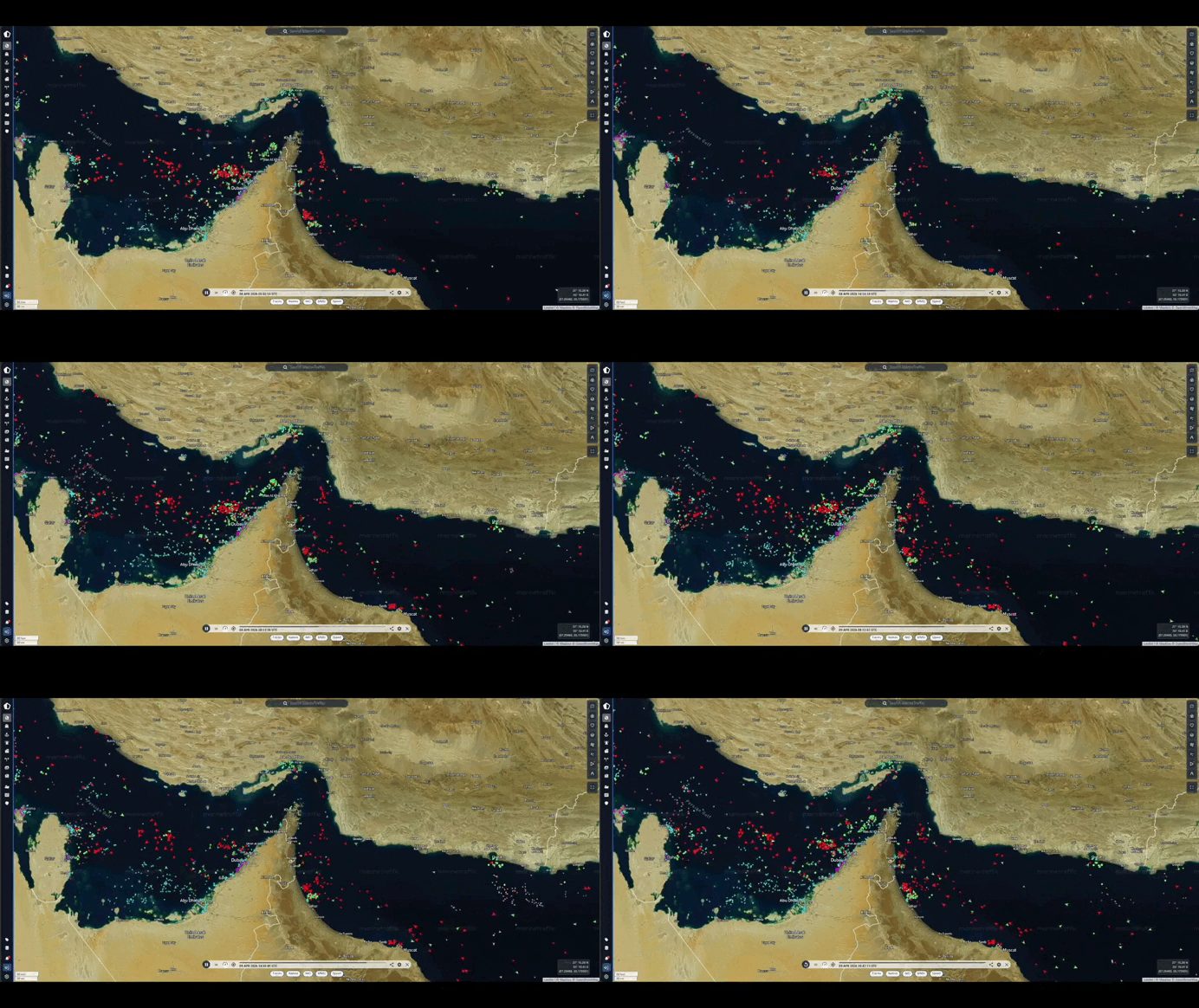
Ship tracking data on MarineTraffic and Pole Star Global platforms show that a chemical tanker bound for India is preparing to transit the strait.
Torbjorn Soltvedt of risk intelligence firm Verisk Maplecroft stated, “Most shipping companies are likely to remain cautious; even with a significant increase in traffic, two weeks is not enough time to clear the backlog of vessels.”
Vess that have already transited the strait in India have stated they have not paid transit fees.
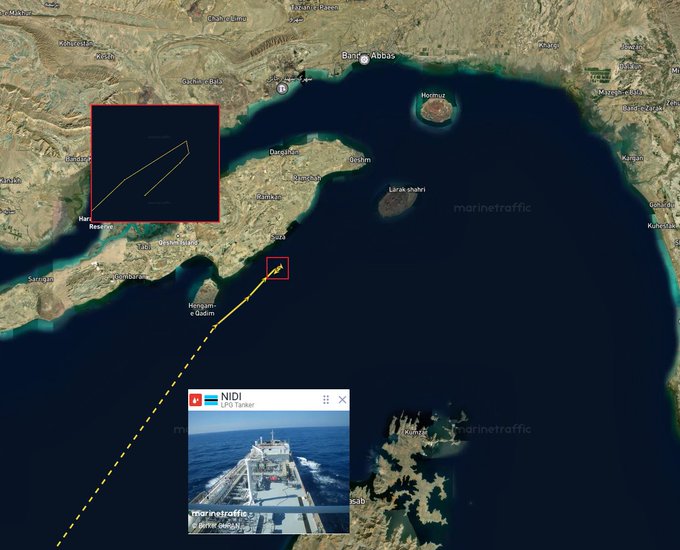
According to Iran’s semi-official Tasnim News Agency on Thursday, the Iranian Islamic Revolutionary Guard Corps has instructed vessels to navigate in Iranian waters around Larak Island to avoid mine risks in the strait’s regular shipping lanes.
Tasnim News Agency, citing the Revolutionary Guard, stated that until further notice, vessels must enter the strait north of Larak Island and exit south of it, coordinated by the Revolutionary Guard Navy.
A consultancy report by British maritime safety firm Ambrey stated that vessels without Iranian authorization still face risks, particularly those with ties to Israel and the United States. The report stated, “Even vessels with apparent approval have been ordered to turn back mid-voyage in recent weeks.”
According to data tracked by MarineTraffic AIS, on Thursday, an LPG tanker made a 180-degree turn while attempting to cross the Strait of Hormuz via a route approved by Iran near Larak Island. This was the second tanker to make a turn on the same route since Wednesday.
It’s worth noting that several media outlets have recently reported that Iran might plan to levy transit fees on ships passing through its straits, with some reports suggesting a fee of $2 million.
However, the Indian-flagged liquefied petroleum gas (LPG) carrier “Pine Gas” recently circumnavigated Larak Island, passing through the Iranian-designated “northern route” of the strait and leaving the Persian Gulf. The ship’s chief mate, Sohan Lal, stated in an interview that the company did not pay any transit fees to Iran, and that the ship was not boarded or inspected by the Iranian Revolutionary Guard.
The International Maritime Organization (IMO), a UN-affiliated shipping agency, stated that there is currently no international agreement allowing for transit fees to be levied on ships passing through international straits. “Any such transit fee would set a dangerous precedent,” an IMO spokesperson said on Thursday.
Mitsui O.S.K. Lines, one of Japan’s three major shipping companies, has recently successfully steered three oil tankers out of the strait. The company’s president and CEO, Jotaro Tamura, said on Thursday that the company is awaiting guidance from the Japanese government on how to continue operations during the two-week ceasefire.
Shipping companies are generally reluctant to take risks.
Currently, although the Strait of Hormuz has nominally reopened, many shipping company executives and analysts say that the uncertainty surrounding the ceasefire still makes transit too risky. Shipping companies point out the lack of clear approval and security guarantees from Iran, clear guidance on how and when to allow navigation, and long-term planning for the strait’s future.
Hapag-Lloyd, the world’s fifth-largest shipping company, currently has six container ships stranded in the strait, but the company intends to keep them anchored.
“Our priority is the safety of our employees on land and at sea. Based on our current risk assessment, we will not transit the strait for the time being,” said Hapag-Lloyd spokesperson Nils Haupt.
In fact, Lale Akoner, a global market analyst at financial services company eToro, believes that shipping traffic could take six months to recover to pre-war levels. This means that the economic consequences of the war—rising energy costs and their various ripple effects—are likely to last far longer than the war itself.
The reluctance of shipping companies to take the risk is understandable: cargo owners are wary of the already fragile ceasefire agreement, especially given the lack of clear guidance on which vessels can pass and when. According to MarineTraffic, as of Wednesday, more than 400 oil tankers, 34 LNG carriers, and 19 LNG carriers remained stranded in the region.
Moreover, ships not only need to leave, but also enter to load the crude oil reserves that have been stranded on land for weeks.
“Shipping operators don’t think it’s worth the risk,” said Joe McMonigle, president of the Center for Global Energy Analysis, a Saudi Arabia-based think tank. “People will be extremely cautious about returning to normalcy.”
Sanne Manders, president of global freight logistics company Flexport, said many shipping executives said they had “no idea” about how to transit during the ceasefire and had not made contact with Iranian authorities.
Ron Widdows, former head of the World Maritime Council, pointed out that shipping companies want “clear approval from those who could harm you.” “How that process works, and which agency has the authority to say ‘yes, you can proceed,’ these things need to be clarified.”
About The Author