
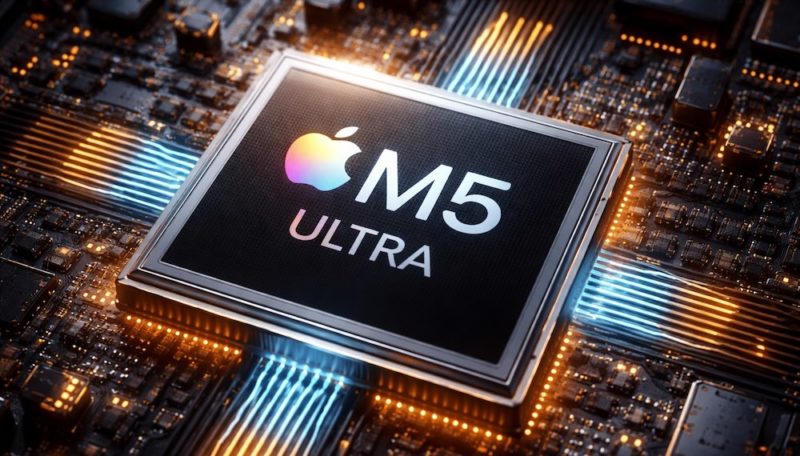
Improving efficiency and reducing costs, Apple’s M5 Ultra may continue using the UltraFusion process
Following Apple’s adoption of the new Fusion Architecture in the M5 Pro and M5 Max, speculation has begun regarding the architecture of the yet-to-be-released M5 Ultra. Recent market news suggests that Apple’s next workstation-class chip may not adopt a completely new monolithic design, but rather continue with the UltraFusion packaging architecture, combining two M5 Max chips to form the M5 Ultra, thus balancing yield and cost control.
Apple announced the M5 Pro and M5 Max last month, stating that both chips use the Fusion Architecture, integrating two third-generation 3nm chips into a single SoC through advanced packaging, thereby expanding the scale of the CPU, GPU, and other modules. However, the much-anticipated M5 Ultra has yet to appear, making the question of whether it will continue the existing UltraFusion approach a focus of discussion.
This speculation stems from Apple’s past design approach for its Ultra series chips. When Apple announced the M1 Ultra in 2022, it connected two M1 Max chips in series using UltraFusion. Similarly, with the M3 Ultra launched in 2025, Apple confirmed that it used UltraFusion to connect two M3 Max chips, utilizing over 10,000 high-speed connection points to allow the system to treat the two chips as a single chip.
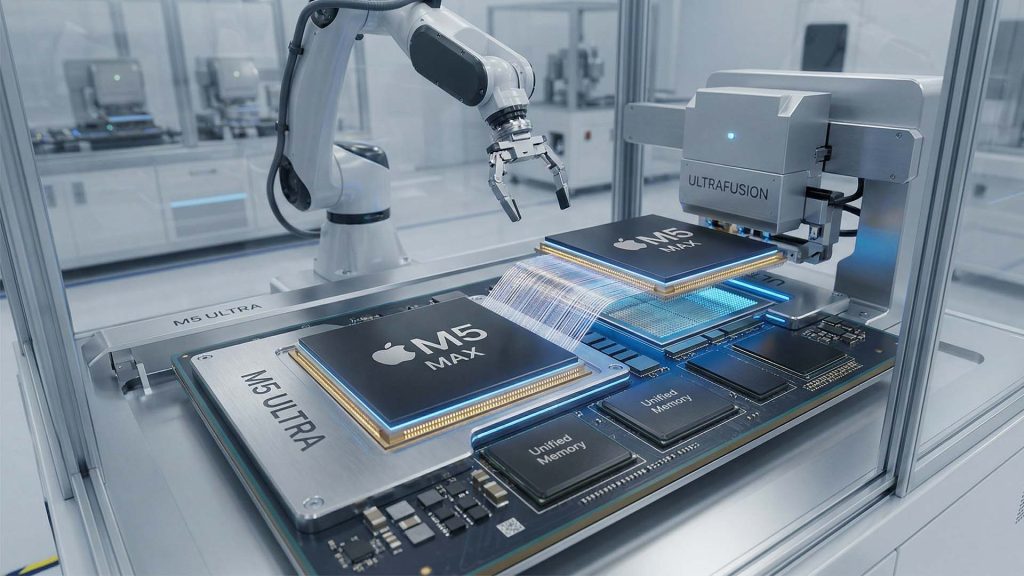
This latest rumor suggests that Apple might stack both technologies in the same generation of products. Specifically, the M5 Max might initially use Fusion Architecture, and then two M5 Max chips might be connected via UltraFusion to form the M5 Ultra. If this comes true, it will be the first Apple Silicon product to combine both Fusion Architecture and UltraFusion.
From a manufacturing perspective, the market’s preference for Apple to continue with UltraFusion is primarily due to its maturity and mass production efficiency. UltraFusion has been repeatedly used in workstation-level products such as the M1 Ultra, M2 Ultra, and M3 Ultra, indicating that Apple has a relatively mature approach to high-end dual-die integration. In contrast, adopting a completely new single-die large-die design would not only carry higher R&D and wafer fabrication risks, but could also put greater pressure on yield and cost.
Based on current leaks, if the M5 Ultra does indeed use UltraFusion, it is speculated that it may still target high-end desktop products like the Mac Studio. When Apple updated the Mac Studio in March 2025, it offered both M4 Max and M3 Ultra configurations, while the future plans for the Mac Pro product line are relatively unclear, leading the market to focus more on whether the M5 Ultra will be the core upgrade focus of the next-generation Mac Studio.
About The Author