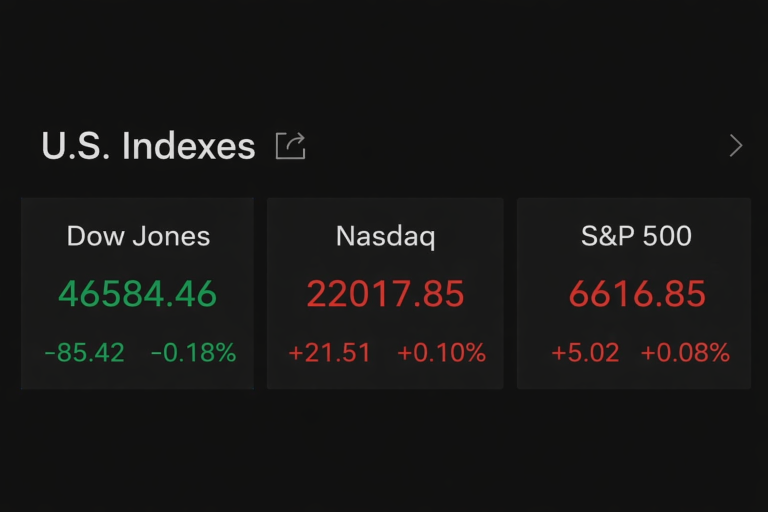

Major US stock index futures rose slightly on Tuesday (April 14) as investor hopes for a peace deal between the US and Iran increased.
At 7:00 AM, S&P 500 futures were up 5.20 points, or 0.08%, at 6891.40; Nasdaq 100 futures, dominated by technology stocks, were up 79.40 points, or 0.31%, at 25463.10; however, the heavyweight Dow Jones futures were down 42.60 points at 48176.50.
Major Wall Street indexes rose sharply overnight (Monday), closing almost entirely higher. Market investors put aside the failure of last weekend’s US-Iran talks and instead hoped for a permanent agreement to end the war in the Middle East. They also focused on the newly started first-quarter earnings season.
The S&P 500 rose 69.35 points overnight to close at 6886.24. The Dow Jones Industrial Average gained 301.68 points to close at 48218.25. The Nasdaq 100 also rose 1.06%, or 267.38 points, to close at 25383.72.
U.S. stock markets were quiet overnight, with total volume on exchanges at 15.9 billion shares, less than the 20-day average of 19.07 billion shares.
Pre-market trading highlights: Chip giant Nvidia denied a report on the news website SemiAccurate, which claimed that Nvidia was preparing to acquire a large company known for “reshaping the personal computer landscape.” Following Nvidia’s denial, Dell Technologies shares fell 2.5% in pre-market trading; HP Inc. shares were also down 1.9% at the time of writing.
Bloomberg, citing sources familiar with the matter, reported that United Airlines CEO Scott Kirby has raised the possibility of a merger between United Airlines and American Airlines. Following this news, American Airlines shares rose 4.7% in pre-market trading tonight, while United Airlines shares were up 1.9% at the time of writing.
Danish pharmaceutical company Novo Nordisk announced a partnership with OpenAI to leverage artificial intelligence for new drug discovery and improve the efficiency of its research and development process. Following the announcement, Novo Nordisk shares rose 2.94% in pre-market trading tonight, reaching $39.08 at the time of writing.
On Tuesday, we’ll look at the latest quarterly earnings report from US investment bank Goldman Sachs. The stock was up 0.38% in pre-market trading tonight, reaching $894.00 at the time of writing.
Pre-market active stocks, in order: Plug Power, Oracle, Intel, Nvidia, and Micron Technology. At press time, all five actively traded stocks were up.
Goldman Sachs CEO Solomon: Initial public offering (IPO) activity cooled in March due to market volatility caused by the war. However, several large IPO projects are still in preparation and are expected to gradually move forward.
Goldman Sachs (NYSE: GS)
Driven by record equity trading revenue and better-than-expected investment banking performance, the U.S. investment bank Goldman Sachs released its quarterly results overnight, exceeding most market analysts’ forecasts.
According to Goldman Sachs’ first-quarter results ending in March, the group’s revenue increased by 14% year-over-year to $17.23 billion, higher than the market expectation of $16.97 billion. Its profit for the quarter increased by 19% year-over-year to $5.63 billion, with earnings per share of $17.55, also better than analysts’ expectations of $16.49.
Since the beginning of this year, major trading departments on Wall Street have been unusually active. As artificial intelligence drives market restructuring, many institutional investors are constantly adjusting their portfolios, boosting trading volume and value. This trend propelled Goldman Sachs’ equity trading business to its best quarterly performance ever.
Goldman Sachs’ results showed that its equity revenue grew 27% to $5.33 billion, exceeding market expectations by approximately $420 million. This growth was primarily driven by increased funding needs from hedge fund clients and a rise in the number of buy-sell transactions in the cash equity market.
Its investment banking business also performed strongly. Related fee income surged 48% to $2.84 billion, exceeding expectations by approximately $340 million, mainly due to a surge in advisory revenue from completed M&A transactions. Additionally, Goldman Sachs saw improvement in revenue from equity and debt underwriting.
In contrast, Goldman Sachs’ fixed income business performed poorly. Revenue in this segment declined 10% year-over-year to $4.01 billion, falling short of market expectations by approximately $910 million. Goldman Sachs executives cited a significant decline in revenue from interest rate products, mortgage lending, and credit operations as the primary reasons for the company’s poor performance.
In asset and wealth management, Goldman Sachs’ quarterly revenue grew 10% to $4.08 billion, but was still about $140 million lower than expected. While increased management fees were driven by expanding assets under management, a decline in private banking revenue partially offset this growth.
Meanwhile, Goldman Sachs’ loan loss provisions increased by nearly 10% year-on-year to $315 million, significantly higher than the market expectation of $150.4 million. This was mainly due to increased loan size and wholesale loan impairments.
Notably, this is the largest increase in loan loss provisions for Goldman Sachs since 2020, prompting investors to scrutinize how the company assesses the credit environment. However, some analysts point out that this may reflect management’s cautious attitude towards future credit market risks.
Therefore, despite exceeding expectations, Goldman Sachs’ stock price only rose slightly by 0.45% overnight, closing at $907.80.
Investors are also focused on the impact of the Middle East conflict, which erupted on February 28, on Goldman Sachs’ future business. In response, Goldman Sachs CEO David Solomon stated in the earnings report that amidst rising overall uncertainty and significantly increased market volatility, the company still delivered strong returns for shareholders. He emphasized that the current complex geopolitical environment means sound risk management remains central to the company’s operations.
Solomon also said that while mergers and acquisitions and other transaction activities have remained resilient overall, the company is closely monitoring developments in the Middle East. A prolonged conflict could put pressure on some business segments in the coming quarters, particularly due to indirect impacts from inflation.
About The Author